The bigger picture6 min read
Doing “something” with AI is easy. Doing it right is the challenge.
Are you looking to do something with AI, but unsure about products, content, and expertise? This article provides an overview of the two things that make AI solutions last: a trusted blueprint for the foundation AI needs, and a guided path from first workshop to long-term governance. The result is a way to start quickly without buying the wrong product or having to reverse your initiative within a year.

For the past year, we have discussed AI with a wide range of organizations, and the same story keeps coming back: “There’s internal pressure to do something with AI, and it should be up and running in a couple of months.” We often hear that the strategy for what AI should help achieve is unclear – yet Copilot licenses have already been bought and are waiting to be used.
There are plenty of other questions too. Should we build on Copilot, invest in an intranet with AI on top, or add another AI platform to the mix? What expertise do we need in-house? How do we judge vendors’ claims that their product meets our requirements?
In short, the worries we hear about include buying the wrong product, content that isn’t fit for purpose, and initiatives that have to be reversed within a year. If this sounds familiar, you are not alone. And each of these worries has an answer.
The AI platform question comes too early
Many of our meetings start with the platform question: Copilot, a new intranet, or some other product? It’s a reasonable question and we understand why it comes first.
Our answer is a boring one, we know: usually, it’s too early to tell. It’s difficult to choose a platform before you know what you want AI to achieve. And before adding new products to the mix, it helps to look at the capabilities you already have and which of them you can build on.
There is another side to this too. AI is only as good as the content it’s built on. When an AI assistant gives a confident answer from an outdated policy, or mixes up which rules apply in which country, the cause is rarely the AI itself. More often, the organization’s information was never structured for AI to understand.
If the goal is simply to get something up and running, you don’t need much more planning. But if you want solutions that last, evolve over time and bring real value to the organization, it pays to do things in the right order. First, find out where your organization stands today and which outcomes you want AI to deliver. Then prioritize use cases and plan how to design, procure, implement and govern the solutions.
Getting AI right takes two things: a clear picture of what the foundation needs to look like, and a long-term way of working to get there. In our work, we call them a trusted blueprint and a guided path.
A trusted blueprint for the AI-ready intranet
The blueprint describes the foundation AI solutions need, whatever platforms you choose. It covers six areas, each described as a model where two dimensions form four quadrants:
- Information: separates organizational information by authority and scope, so AI knows what to trust and where it applies.
- Communication: clarifies how different types of communication should be treated, including who needs them and how much attention they deserve.
- People: structures the context AI can use about employees, based on the authority and scope of that information, while keeping privacy boundaries in place.
- Metadata: creates shared meaning across the organization by defining how concepts and terms are governed and where they apply.
- Orchestration: guides how work can be supported or performed, based on how predictable it is and how much autonomy AI can safely be given.
- Front Doors: maps the ways employees reach information and services, from designed experiences to AI that adapts in the flow of work.
As you can see, the blueprint is about your organization rather than any particular platform: your information, workflows and governance, and how easily employees can reach what they need. An employee in Sweden asking about meal expenses should get the current Swedish guidance, not the global policy or an old PDF. That only happens when the foundation makes clear what applies to whom.
We have worked with versions of these models for more than 20 years, long before AI, and they matter even more now that AI depends on them.
A guided path to an AI-ready intranet
A blueprint shows what the foundation should look like, but not how to get there. That takes a way of working that lasts beyond the first use case: from understanding your needs, through design and procurement, to managing solutions over time. Our suggested path covers seven stages:
- Inspiration Workshop: Explore what an AI-ready intranet could do for your organization, shown through use cases based on your own priorities.
- Readiness Assessment: Understand your current situation – what you can do today, what needs to be prepared or procured, and a realistic timeframe.
- Strategy and Roadmap: Define your ambition and direction, prioritize use cases, and decide on a roadmap to get there.
- Solution Design: Use the blueprint to turn prioritized use cases into concrete solution requirements, before you decide what to buy.
- Procurement: Find the right solutions and partners by focusing on what makes a real difference for your use cases, tested with your own content.
- Implementation: Implement solutions that achieve the desired outcomes, validated with real employee questions and ready to be owned and run.
- Continuous Governance: Track results, manage content and AI over time, and stay ready for what’s next.
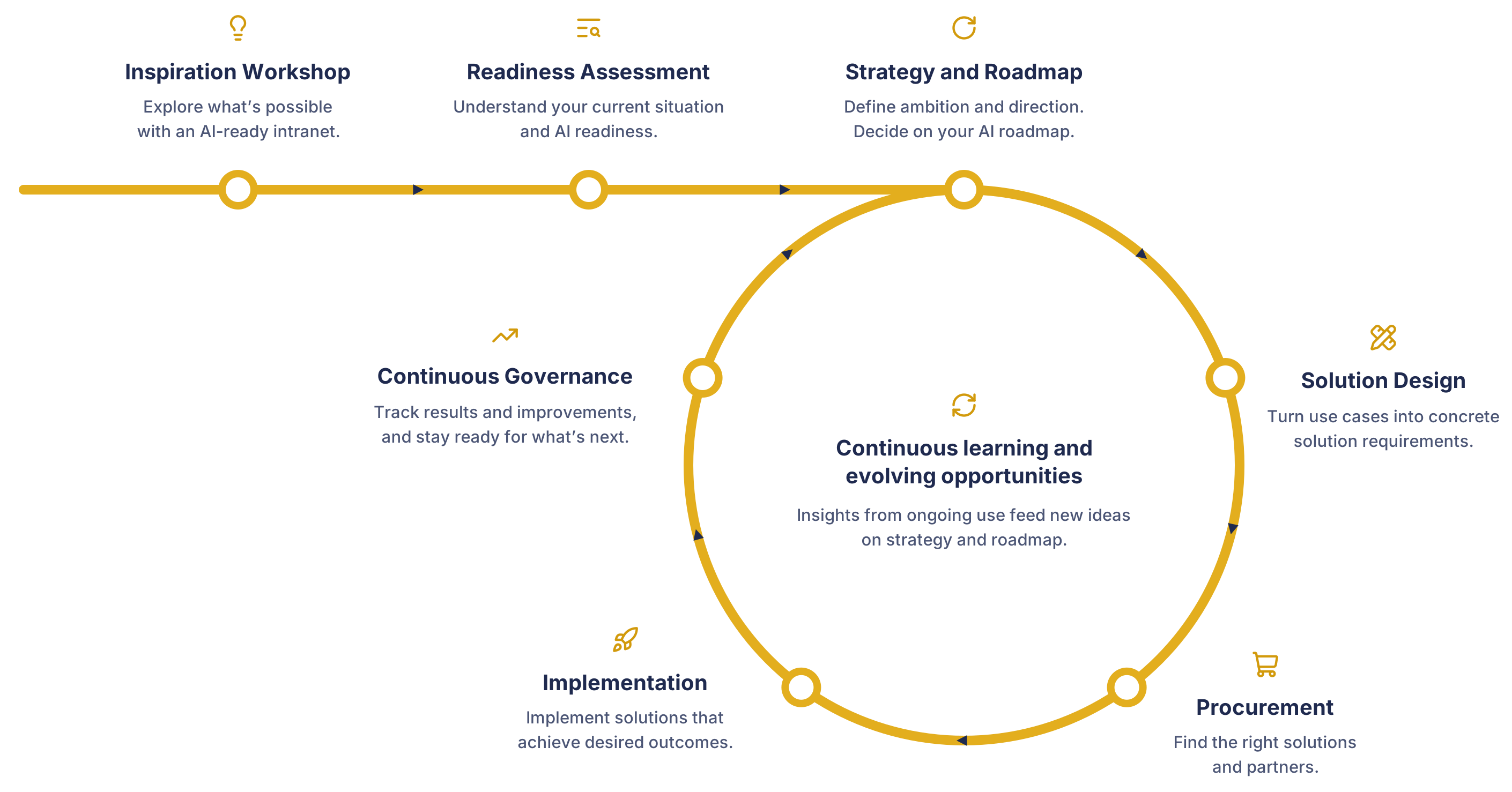
The path is not strictly linear, and it doesn’t end with governance: insights from ongoing use feed new ideas back into strategy and roadmap. Nor do you need to complete every stage in full before you start. A first use case can move through the stages quickly, and the next one builds on what is already in place. What matters is the order: knowing what you need before you design, and designing before you buy. That saves you from the most expensive mistakes, like buying a new intranet when the real problem was governance.
Want to learn more about getting AI right?
You can read more about the first two stages of the guided path in our articles on what an AI-ready intranet could do for your organization and whether your intranet is ready for AI.
Both the trusted blueprint and the guided path are described in detail in our upcoming book, The AI-Ready Intranet: Why, What, and How? It launches in January 2027, and you can sign up on the Infoworks website to get a reminder when it’s available.
Can’t wait until January? Book a first conversation with us about how we can help you get AI right. We sell no AI or intranet products, so our only interest is your outcome.
Time to do “something” with AI? Let’s make sure it’s the right something.